Saturday, April 7, 2018

Castillo San Felipe de Barajas


On Monday we visited Castillo San Felipe de Barajas, together with the walled city a UNESCO world heritage site since 1984. 


It took us only twenty minutes or so to reach the castle. Since it was still relatively early we were surprised to see a long line-up of people at the ticket counter already. We had not taken into account that Cartagena is a favourite stop for cruise ships, and of course the castle is part of the city tour. 


Standing at the foot of the hill on which it is built it looked formidable, its high, bare walls forbidding in the already glaring sun. The castle itself is 160m wide and 260m long and was defended by 63 canons, as we soon learned – once we had figured out how to use the audio guide, which took a little while since the stations were not marked at the castle itself, only on the map we had received with the guide. We slowly made our way from one station to the next, heard how the fortification grew from the first defensive tower to the impregnable castle it had become by the end of the 18th century. The city was plundered after the Raid on Cartagena by French buccaneers in 1697. It was besieged by a large English armada commanded by Admiral Vernon in 1741, which ended with the English giving up due to a lost battle at the Castillo and the toll tropical diseases like malaria and yellow fever rampant in the swamps adjacent to the city took on the soldiers.


Then followed a period of relative calm and great prosperity, during which the grand colonial houses, palaces, libraries and printing establishments were built. The 275-year long period of Spanish rule came to an end with the Latin American wars of Independence. 


On November 11, 1811 the Declaration of Independence was signed. This independence was short-lived, however: in 1815 Spain sent a ‘Pacifying Expedition’ and placed the city under siege from August to the beginning of December. The citizens were starving, but they were determined not to give in. By the end of the siege, however, about 300 per day died of starvation or disease, so that the Spanish were finally able to enter the city. 

Finally, a patriot army laid siege to the city from August 1820 to October 1821 and was able to gain the upper hand. Simón Bolívar, the Venezuelan military and political leader who played a central part in the establishment of Venezuela, Bolivia, Colombia, Ecuador, Peru, and Panama as sovereign states, gave Cartagena the title ‘La Heroica’, the heroic city, for its determined resistance during the siege. 


Listening to the recounting of these historic events we gained ever more respect for the engineers of this huge walled fortification and the men defending it bravely, sometimes against huge odds. Looking at the highrises of the newer parts of the city it is hard to imagine that insect-ridden swamps once covered the area where they stand now, but after being exposed to sandflies and mosquitoes on our hikes we knew that they would have been a formidable ally for the defenders, especially since there were no means to treat the diseases they spread.
We admired the high, thick walls, gazed through the small openings through which tar was poured on attackers trying to scale them, and had a chance to see part of the strategically designed tunnel system in these walls where defenders lay in ambush. After almost two hours we finally stood on the Santa Barbara battery, the last station of our tour, the only ones except a policeman who had followed us down there, nodded a friendly greeting and was leaning against a post, probably happy for the shade, just like us. Was he there to make sure we weren’t up to any mischief or for our protection? Hard to tell; as everywhere in Cartagena, indeed in many places, there was a strong yet unobtrusive police presence at the Castillo, too. We stood under the roof covering the battery and looked up to the top of the Castillo. Whoever ended up at this battery at a battle would have been almost certain to lose his life here, cut off from the castle at this exposed spot. It wasn’t hard to imagine what it might have felt like when we looked across to the walls above.


Friday, March 30, 2018

Return to Cartagena

Little more than a week ago we gradually made our way back from everlasting summer to the reality of a spring that is spring only by name. With each flight we moved a bit further away from the Colombian coast’s thirty-plus degrees with eighty-plus percent humidity; at each airport we stepped outside for a few minutes to feel the difference. In Bogotá, early in the evening, I enjoyed the cooler air, thought, just for a moment, with just a tinge of regret that I missed not to have even seen the highlands this time. The climate would have been easier for me to deal with – but I quickly suppressed that ungrateful notion. In Toronto, early in the morning, I saw no snow, and the air, just above the freezing mark, was still. ‘This is not so bad,’ was my observation here. ‘If it’s like this at home …’  In Edmonton, standing outside the departure area door waiting for Carl to pick us up, I wished I had my winter jacket instead of the fleece jacket when the wind drove thin snow into my face. Even from the air we had been able to see that the ground was still white. Back to the reality of home, four times closer to the Arctic Circle than to the equator. Past experience taught me that it doesn’t take long to adjust.

So, how to get from here

back to here?
 It requires a mental leap, admittedly, but it is also very tempting, especially since the sunshine in the first picture has given way to more light snow, temperatures way below where we feel they should be (-9 today, -24 expected overnight), the average depth of snow in the yard still at 37 cm, and wind. Going back to Cartagena, where we spent the last few days of our Colombia trip, sounds like a very pleasant task on a day like this.


We had planned to spend the last few days in Cartagena, by all accounts a beautiful city with its well preserved colonial buildings. When we arrived we were eager to get to Santa Marta for the hike to the Ciudad Perdida: conditions were ideal with the dry weather, and there was no telling when they might change. Since this was the most important undertaking of our trip we wanted to make sure to do everything to make it happen. Thus we had decided then to postpone the exploration of Cartagena's old city till the end. Originally we had planned to take the bus from Cartagena to Bogotá, from where our flight was leaving for Toronto, but when we found a very cheap flight we changed our plans to have more time at the coast. 


No big buses go to Minca because of the narrow, very winding road, so the first part of the trip took place in one of the big vans travelling between Minca and Santa Marta. We had heard that we could get the ticket to Cartagena in Minca already, and if we had understood the man selling us the tickets correctly we’d just have to let our driver know that we wanted to continue on to Cartagena. Even with diminished weekend traffic it took a long time to make our way to Santa Marta’s centre where, we expected, we would end up at the place from where we left at the beginning of the week, trusting that the bus to Cartagena was leaving from that same curbside spot. We recognized the area and kept our eyes open for the calle we remembered, but suddenly the van stopped, the driver said something about Cartagena and indicated that we were to get out. Now what? But no worries: he unloaded our backpacks, hailed a taxi, gave the driver instructions and money – and just like that we were whisked away. Of course we felt a bit at the mercy of the forces that be, but we trusted that the taxi driver knew where we needed to go (obviously much better than we did), and really, after not even ten minutes he stopped in front of a ‘Marsol’ bus office. Everything was in order, and we had about another hour until the bus was leaving for Cartagena. The office, empty but for a ticket counter and a few chairs along the walls, was pleasantly cool and, like so many public places in Colombia, had Wi-Fi. 


Later, on the bus to Cartagena, a boy of maybe twelve or thirteen was my neighbour. He was fiddling with his phone, intermittently listening to it, and seemed a bit bored. While I was still trying to figure out how to start a conversation, feeling his eagerness to break the monotony of the trip by talking to me but reluctant to address a kid that age in my rudimentary Spanish, he asked me in only slightly accented English where I was from. Well, that was much easier than I had expected! It turned out that he was he was living with his Greek father in Baranquilla, a good-sized industrial city between Santa Marta and Cartagena, and was on his way to visit his Colombian mother in Cartagena. He had lived in Belgium until he was ten, and his father speaks English with him. He had many questions and comments and was not shy at all, so time passed quickly, and I found out a little about the life of a (rather well-to-do) kid in Colombia. I couldn’t help but wonder what a conversation with a kid from one of the poor areas of Cartagena would have revealed. 

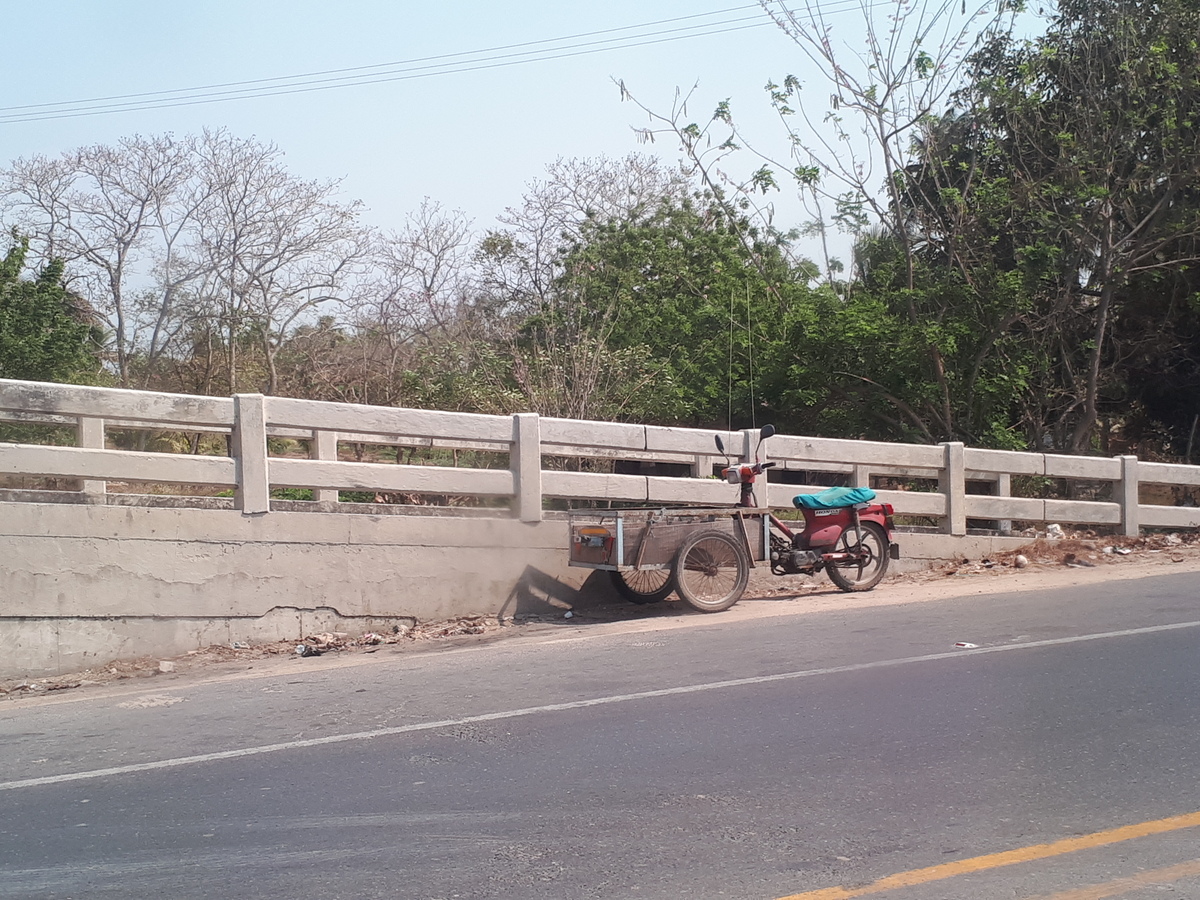
 A couple of pictures snapped during the bus ride to Cartagena. There are dozens of these little shops-cum-restaurants in the small towns along the road. This one is uncharacteristically empty.

We were less lucky with the taxi driver who was to take us to our small hotel in Getsemaní, hailed as ‘Cartagena’s up-and-coming neighbourhood’ (price and convenience, not that label being the reason for our choice of a place to stay). He nodded when I showed him the address, turned from the ring road between the beach and the city wall and entered the grid of narrow streets of Getsemaní. After going briefly through a one-way street the wrong way he stopped at busy ‘Plaza la Trinidad’ to let us out. We looked at our map, a bit confused as to where we were. Hadn’t we just passed through ‘Tripita y Media’? Now the sign said ‘Calle del Guerrero’, but it seemed to us that we were still in the same straight street. Shouldering our packs we walked back along the way the taxi had taken us. After the next intersection the name of the street changed again; now it was called ‘Calle de San Andrés’. Could we have been so wrong? We kept going, however, and finally saw the ‘Tripita y Media’ sign again. Now it didn’t take us long to find the entrance to ‘Casa Victoria’, our hotel. Why the taxi driver had chosen to drive right past and let us out ten minutes from our destination will remain a mystery. We could have done without it.