
Our hotel turned out to be in a great location, close enough
to walk almost anywhere in the old city, yet far enough away from the most tourist-swamped
locations. Our room itself was quite small, but the roof-top seating area, just a short flight of
stairs up, provided some shade and usually a light breeze in the afternoon and
a quiet enough place to sit outside in the evening, so the size of the room didn't matter much, and the air condition made it possible to sleep comfortably. As mentioned earlier, Calle Tripita y Media is part of the Getsemaní
neighbourhood, with its share of nice colonial houses, but still an area where
people live and work and where hardware stores, repair shops, butchers, tailors,
hairdressers and small tiendas – stores
– are visited more by locals than tourists. People walk as much in the street
as on the narrow sidewalk, stepping aside for cars or the many hand-pushed
three-wheeled carts with which anything from fruits and vegetables to machinery
parts is transported. Breakfast was included in our hotel stay, but the hotel
itself didn’t have a restaurant; instead, we walked a few metres down the
street to a small restaurant with which the ‘Casa Victoria’ had a breakfast
arrangement. Here, we could sit right by the open door and watch the early
morning crowd pass by while eating our typical Colombian breakfast of a plate
of fruit and freshly squeezed ‘jugo’ – fruit juice - , scrambled eggs with
tomato and onion, arepas (a staple
Colombian food: thick fried pancakes made with maize flour, served on their own
or with cheese or other ingredients), patacones (thinly sliced fried green plantain), or, if desired, bread, though mostly white and
untoasted. We got quite used to the patacones, which are thin and crispy,
though not so much to the arepas, at least not for every day.
Unvaryingly, by the
time we were ready for the day’s explorations it was already hot – not that it
cooled down much at night anyway: at about 25 degrees Celsius an air
conditioned room, or at least one with a fan, was very much appreciated. During
the day, at 30 to 33 degrees, it was advisable to stick as much as possible to
the shady side of the street. Close to the beach the breeze made it more
pleasant, but in the maze of narrow streets it was like walking in an oven.

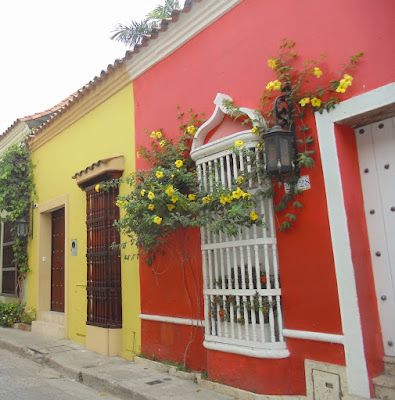


On Sunday we explored Getsemaní, enjoying the colonial
houses in bright, contrasting colours, sometimes quite daring, taking in the
atmosphere and getting oriented. We crossed the ring road to walk along the
waterfront for a while, not directly on the sandy beach as on the first day
because here only a narrow band of huge yellowish coral rocks separated the
road from the ocean, and spray from the breakers sometimes reached us on the
sidewalk. After a while we crossed back over and walked for a while on the wall
surrounding all of old-town Cartagena, also called ‘The walled city’, 11 km
length in total.

This battlement was part of the fortification built to
defend Cartagena, once Spain’s most important port in the Americas, against
attackers of all sorts. We visited the Castillo San Felipe de Barajas on Monday (see next post).



 |
| India Catalina |
Inquiring about city tours at one of the hostels we found
out that a free walking tour – in English - started at ten every morning at the
naval museum, so that’s where we were headed on Tuesday morning. This was a
great decision! Edgar, our very knowledgeable guide, introduced many of the
city’s historically important places to us and managed to do it in an
entertaining way. We heard about the city’s founder, the Spanish commander
Pedro de Heredia, and his indigenous guide India Catalina whose statue we saw
on our way to the airport the next day. Small replicas of the statue are handed
out at the Cartagena Film Festival – ‘our Oscar’, Edgar joked. We stopped at
the triangular Plaza de los Coches where slaves were sold after being brought
to Cartagena from Africa. They played a major role in part of the construction
of Castillo San Felipe de Barajas, for instance, and were brought to many
different parts of South America from here. Now, several plaques throughout the
old city remind of the fate of these men and women.
We had originally planned to visit the small town of
Palenque, about an hour and a half’s drive from Cartagena, which was founded by
escaped slaves in the 17th century. Their leader, Benkos Bioho, led
other escaped slaves to this place where they established a palenque – a walled
city – the first one of many all over Latin America and the only one still
inhabited by descendants of the original inhabitants. Here, they continue to
preserve their African heritage – Palenquero language, music, cuisine, dress
and traditions – and in 2005 the village was declared
Masterpieces of the Oral and Intangible Heritage of Humanity by UNESCO. To have
the full benefit of a visit to the town we would have needed a guide, and none
was available for the two remaining days. We did see the Palenquero women in
the squares of Cartagena, however. With their colourful dresses and huge
platters of fruit on their heads they are favourite photo objects for tourists.
We were also lucky to watch a high energy dance performance by a group of young
Palenqueros in one of the parks on Sunday.

Edgar explained that the houses in the old
city are built in two styles, either one-story laid out around a courtyard, or
two-story. We had admired the bold colours and beautiful balconies. Now we
learned that the houses had been white and black until the cruise ships brought
a much bigger influx of tourists. Now, the government decreed that houses were
to have bright colours, and people have to follow their guidelines regarding
colours, plus, of course, the preservation of the historic city is assured as a
UNESCO world heritage site. According to Edgar the wooden balconies stem from
the colonial era.


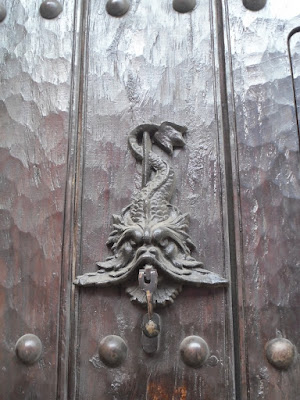
For me, one of the especially fascinating
things in the old city were the beautiful door knockers. I had noted that they
came mainly in four distinct shapes: lion, fish, mermaid and lizard. Now,
during the tour, we heard that these had some significance going back to
colonial times: fish and mermaids indicated that the owner had something to do
with fishing and the sea, while lions represented power and strength. Lizards
belonged to the most highly regarded families. One kind of knocker I didn’t get
to photograph was the hand, representing the clergy. I could have spent days
walking around looking at the different knockers on these massive wooden doors.


And finally it came, our last day in
Colombia. Our flight to Bogotá left at a quarter past five in the afternoon, so
we had plenty of time to get to the airport after checking out of our hotel at
one. We decided not to take a taxi but walk to the bus stop where the airport
shuttle was supposed to leave. Once again I marvelled how, after only a few
days, a city can become so familiar. Street names, buildings and landmarks take
their place on the inner map and no longer need full concentration, making it
possible to pay attention to many other things. I like that.

At the bus stop we couldn’t find any white
buses with green writing and an ‘airport’ sign in the window, but a collectivo, a regular taxi that takes as
many people as can be fit in, was a good alternative, and likely even cheaper.
The driver let us out at the turnoff to the airport where we had stood three
weeks ago on our first night, trying to get our bearings as to where our hotel
was. After the first couple of days spent in that area of Cartagena – Crespo –
we had no trouble getting oriented here anymore either. We checked in at the
Avianca counter, got rid of our big bag and had another couple of hours or so till
boarding. What better way to spend them than having lunch at the restaurant
where we had eaten on our first evening where Johann had been served ‘baby beef’
as tender and well prepared as in Argentina (was that really possible?) and I
had enjoyed the first of many great seafood dishes of our stay. It wasn’t quite
as good as we remembered – maybe the second time never is – but we enjoyed it,
very conscious of the fact that this probably would be the last time in many
weeks that we’d be able to sit outside to have lunch.

How right we were with that assumption! We
have been home for almost three weeks now, and it is still very much winter.
Only the last three days the mercury managed to move past the freezing mark,
and not by very much. But the starlings are back, I saw a red-tailed hawk a
couple of days ago and gulls in the city yesterday, and here and there a
solitary goose wings overhead, scouting, I assume, for the flocks waiting
eagerly for this long winter to finally be over, just like us.


